"A high-quality computing education equips pupils to use computational thinking and creativity to understand and change the world".
The National Curriculum for Computing
This area of our curriculum is led by Miss Curry. Her role is to provide the professional leadership and management for computing to secure high-quality teaching, effective use of resources and improved standards of learning and achievement for all pupils. Miss Curry has been leading this area of the curriculum since September 2023. She says:
"At Market Weighton, we aim to prepare our learners for their future by giving them the opportunity to gain knowledge and develop skills that will equip them for an ever-changing digital world. The teachers at Market Weighton have an obligation to ensure that children understand how to use computers effectively, efficiently and safely. Our Computing curriculum focuses on a progression of skills in digital literacy, computer science, information technology and online safety to ensure that children become competent in safely using, as well as understanding, technology. These strands are revisited repeatedly through a range of themes during the children’s time in school to ensure the learning is embedded and skills are successfully developed."
The key elements of the National Curriculum's programme of study for computing have been organised into a set of hierarchical statements to ensure that children accumulate more and more computing knowledge as they progress from Foundation through to the end of Year 2. Teachers are aware that planning must always have an eye on longer-term learning and the part that computing knowledge building plays in this.

|
Progression in computing | [pdf 188KB] |

|
|
|
National Curriculum - Computing key stages 1 to 2 | [pdf 86KB] |
|
Intent: What do we want children to know about computing by the time they leave our school?
Aspiration: we want our children to nurture their curiosity about the safe use of technology and provide them with the aspiration to go on to learn more about computing in their future schooling.
Independence: Children are taught a range of skills over time to help them to develop independence in critical thinking and working with different mediums of technology (eg. online research, digital photography, presentations, coding and more importantly staying safe). Children learn appropriate vocabulary that will help them to investigate.
Motivation: We aim to develop children’s motivation and to capture children’s interest in computing so that they develop an awareness and an interest in their future and be able to think critically.
Children will be taught to:
- understand what algorithms are; how they are implemented as programs on digital devices; and that programs execute by following precise and unambiguous instructions
- create and debug simple programs
- use logical reasoning to predict the behaviour of simple programs
- use technology purposefully to create, organise, store, manipulate and retrieve digital content
- recognise common uses of information technology beyond school
- use technology safely and respectfully, keeping personal information private; identify where to go for help and support when they have concerns about content or contact on the internet or other online technologies.
Links with British values and PSHE (Personal, Social & Health Education)
|
Pupils are taught to:
|
|
Collaborative work in computing develops mutual respect for the differing opinions, beliefs and abilities of others. In addition, children develop a respect for the resources used and understand the importance of looking after them. They learn to appreciate the value of similarities and differences and learn to show tolerance. A variety of experiences teaches them to appreciate that all people – and their views – are equally important. Children are encouraged to work in a democratic way, exercising the ‘give and take’ required for successful teamwork, this is particularly true of topics which require children to work in groups to research or to design and create a product. Computing also enables children to appreciate the importance of staying safe online and respecting others.


Implementation: How is computing being delivered?
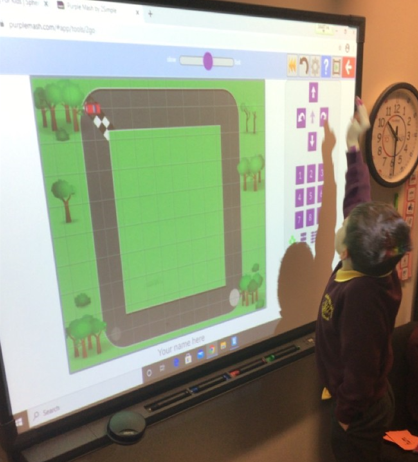
We follow the programme of study for computing in the National Curriculum (2013). In the Foundation stage, there will always be a digital element to on-going provision and children learn to use basic equipment such as cameras and Beebots. Children are first introduced in the Foundation Stage to Purple Mash by exploring different programmes. In Years 1 & 2, computing is woven into cross curricular activities, but is also given a dedicated time in the week. In these sessions, there should be a focus on contextual skill development and these sessions should provide experiences which can then be applied in other work. Children will have access to the hardware (computers, tablets, programmable equipment) and software that they need to develop knowledge and skills of digital systems and their applications. This is done through Purple Mash and other programmes such as Scratch Jnr.
Teachers will foster a managed, rather than a ‘locked down’, approach with the use of Internet research. Pupils need to learn how to use technology safely, respectfully and responsibly and not to have their responsibility for this taken on by others. Wider curriculum links and opportunities for the safe use of digital systems are considered in wider curriculum planning.
Progression in computing
As children move through the school, teachers choose relevant topics and plan their activities carefully so that children’s learning is progressive. In computing, we have taken key elements of the National Curriculum and organised them into a set of hierarchical statements. This make expectations of progression very clear to teachers when planning their computing lessons. These are:
Progression in digital literacy
Progression in computer science
Progression in information technology
|
|
Progression in computing at Market Weighton Infant School | [pdf 188KB] |
|
| This document explains what your child will learn in computing in each year group as they move through the school. |
Staff Training
Teachers and support staff are periodically invited to workshops to share ideas across year groups and give or gain insight into what each year group has been learning. This allows staff to upskill themselves using the equipment and applications that the pupils will be using.
Impact: How is computing enriching the learning of our children?
Our children are confident using a wide range of hardware and software, and are diligent learners who value online safety and respect when communicating with one another. Children are able to use technology to accomplish a wide variety of goals, both at home and in school.
Children have a secure and comprehensive knowledge of the implications of technology and digital systems. This is important in a society where technologies and trends are rapidly evolving.
Children can apply the British values of democracy, tolerance, mutual respect, rule of law and liberty when using digital systems.
Our next steps
- Further update and improve the computing curricuum: Schemes of work, software and appications will be updated so that staff have the resources to deliver a high quality curriculum.
- Support and guide staff in use of apps and websites to further enhance earning, across the breadth of the curriculum; quipment wil be updated so that staff have the resources to deliver a high quality curriculum. Our staff will be confident in their use of technology so that software and hardware are incorporated into a wide range of subjects and topics.