English
"When I read great literature, great drama, speeches or sermons, I feel that the human mind has not achieved anything greater than the ability to share feelings and thoughts through language."
James Earl Jones
This area of our curriculum is led by Mr Parker. His role is to provide the professional leadership and management for English to secure high-quality teaching, effective use of resources and improved standards of learning and achievement for all pupils. Mr Parker has been leading this area of the curriculum since September 2022.
He says:
“English isn’t just about learning facts, reading books and writing stories, it permeates every aspect of our lives. It is vital that our young children grow up with a mastery of our language. They need to be able to speak the language confidently in order to make themselves understood and explain their needs, wishes, thoughts and opinions. Our youngest children have opportunities to practise honing these skills through play and delight in explaining their amazing ideas. As they progress into Year 1, they begin to develop greater understanding of the need to structure their thoughts for different purposes and are taught how to present their ideas in written form.
I have been focusing on ensuring that our children are receiving quality teaching in their phonics lessons so that they are making good progress in their reading. We want our young children to come home and proudly share with parents their success in decoding and reading words speedily."
We use the Read Write Inc scheme and have purchased texts to support the development firstly of blending sounds for reading in Foundation 2, continuing onto greater fluency in Year 1 and finally acquiring understanding of the texts they are reading in Year 2. Teachers are aware that planning must always have an eye on longer-term learning and the part that knowledge building plays in this.

|
Foundation Progression in READING and WRITING | [pdf 355KB] |

|
|
|
Y1 Progression in READING and WRITING | [pdf 668KB] |
|
|
|
Y2 Progression in READING and WRITING | [pdf 663KB] |
|
|
|
Handwriting Policy | [pdf 182KB] |
|
|
|
National Curriculum - English key stages 1 to 2 | [pdf 1MB] |
|
Intent: what do we want children to learn in English by the time they leave our school?
Aims of teaching English
We believe that helping children to take their first steps as speakers and listeners, readers and ultimately writers, can help our children to achieve our school’s core purpose:
To help children to do today what they will be able to do independently tomorrow by becoming confident, successful life-long learners and responsible citizens.
How does English contribute to this?
First and foremost, children love to speak! They chat as the play and use words to help them learn. We need to build on this ability through being good role models for standard English, by shaping their thoughts and giving them new vocabulary through high quality stories and other texts. We teach our children phonic skills to enable them to blend and segment words in order to take their first steps to becoming fluent readers and competent writers.
Aspiration: we want our children to love reading for pleasure as well as for information and to begin to appreciate our rich and varied literary heritage. We want them to understand how to write for different purposes which will provide them with the aspiration to go on to enjoy English in their future schooling.
Independence: children are taught a range of skills over time to help them to develop independence in reading and writing. They learn how to use phonics to blend words for reading and how to segment sounds for spelling to enable them to write clearly and coherently for different purposes. They learn how to read books for understanding as well as for fun. They learn how to imitate texts to personalise them and adapt them to create new texts. Above all, we aim to teach children to read easily and fluently by reading often for both pleasure and information.
Motivation: we aim to develop children’s motivation and to capture children’s interest in English by hooking them in. For our youngest children this is ‘child led’ and comes from the rich exciting environment we provide, both in and out of the classroom. By the end of Key Stage 1 we expect that our children will be competent in both speaking and listening so that they are ready to apply their English skills in other areas of the curriculum and in everyday life. We aim to help children acquire a wide vocabulary that they can apply in their reading, writing and spoken language in order to learn.
Links with British values and PSHE (Personal, Social & Health Education)
Our English curriculum offers an excellent context for developing many of the worthwhile skills and understanding that are intrinsic British values and form part of the PSHE curriculum. It provides opportunities to for our children to begin to:
1. Practise critical thinking skills
2. Understand democracy
3. Be active and participative
4. Become sensitive to, and tolerant of, diversity and be concerned with social justice
5. Develop a sense of their own and others’ identity and appreciate their membership within communities
6. Develop their ethical and personal values
7. Consider significance of issues, actions and interventions, or failure to act
8. Make connections between cause and consequence

Implementation: how is English being delivered?
Choice of content
We follow the Statutory Framework for the Early Years Foundation Stage (September 2021) and the National Curriculum (2013) programmes of study for English. which provides teachers with the flexibility to teach the skills outlined in the document through interesting and high quality texts and stimulating environments.
To teach reading and writing at Market Weighton Infant School, we use a scheme called Read, Write Inc because it meets the DfE’s criteria for an effective systematic synthetic phonics (SSP) programme. A complete SSP programme is one that provides:
- all that is essential to teach SSP to children in reception and key stage 1 years of mainstream primary schools
- sufficient support for children in reception and key stage 1 to become fluent readers
- a structured route for most children to meet or exceed the expected standard in the year one phonics screening check
- all national curriculum expectations for word reading through decoding by the end of key stage 1
Implemetation: speaking and Listening
Pupils need to both talk well and learn through talk. Adults are key to helping our young children to develop their speaking and listening skills.
At Market Weighton Infant school, staff act as excellent role models in the first instance, modelling how to use language in everyday situations. They teach new vocabulary in many other different ways such as through exciting topic work or daily story-time sessions with quality literature.
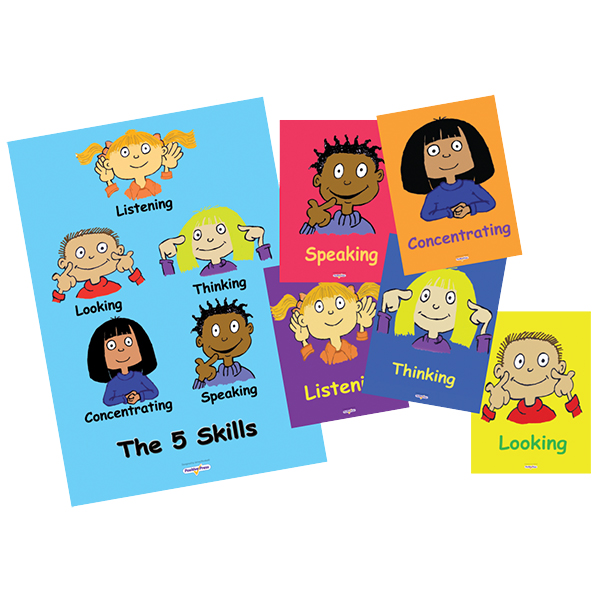
Children are taught how to communicate with others using our ‘Circle Time’ rules linked to the 5 skills: Speaking, Listening, Looking, Thinking and Concentrating. These 5 skills enable children to learn from a very young age the importance of taking turns to speak (often when a special object is passed around). They play games to develop the skills of thinking and concentrating before speaking. They learn the importance of looking at the speaker and to listen to their friends so that they can respond appropriately. This is reinforced through our Golden Rule- “We listen, we don’t interrupt.”
From our school nursery onwards, children are introduced to the world of story-telling through a powerful approach to improving communication and imagination called "Tales Toolikit"‘. This uses easy to remember symbols to represent story structure and gives children the scaffold they need to begin storytelling. This is ably supported by dramatizing our children’s tales delivered as ‘helicopter stories’ as ser out in Trisha Lee's book "Princesses, Dragons and Helicopter Stories: Story-telling and Story Acting in the Early Years".
Teachers organise visits from theatre groups to bring the written word to life. This has included touring productions of "The Little Princess" by Frances Hodges Burnett, "The Reluctant Dragon" by Kenneth Grahame and "A Midsummer Night's Dream" by William Shakespeare. The shows involve audience participation as well as small acting roles to provide childtren with the opportunity to develop their speaking and listening skills.
All children take on roles in our own school productions from Nursery to Year 2. They learn the value of memorising lines and speaking clearly with voice projection. All children join in the singing, learning many songs, which give them a good grounding in acquiring vocabulary to use in their reading and writing as well as contributing to confidence in speaking aloud.


|
|
Foundation Stage reading and writing progression | [pdf 360KB] |
|
|
|
Y1 reading & writing progression | [pdf 691KB] |
|
|
|
Y2 reading & writing progression | [pdf 725KB] |
|
Implementation: reading
Learning to read is the most important thing your child will learn at our school. Everything else depends on it, so we put as much energy as we possibly can into making sure that every single child learns to read as quickly as possible.
We want your child to love reading – and to want to read for themselves. This is why we put our efforts into making sure they develop a love of books as well as simply learning to read.
How will my child be taught to read?
We use a programme of systematic synthetic phonics called Read, Write, Inc. We start by teaching phonics to the children in the Reception class. This means that they learn how to ‘read’ the sounds in words and how those sounds can be written down. This is essential for reading, but it also helps children learn to spell well. We teach the children simple ways of remembering these sounds and letters. Ask them to show you what these are. Children in our Nursery are introduced to the first set of vocabulary and sounds they will need when they start school to give them a head start.
The children also practise reading (and spelling) what we call ‘tricky words’, such as ‘once,’ ‘have,’ ‘said’ and ‘where’.
The children practise their reading with books that match the phonics and the ‘tricky words’ they know. They start thinking that they can read and this does wonders for their confidence.
The teachers read to the children, too, so the children get to know all sorts of stories, poetry and information books. They learn many more words this way and it also helps their writing.
How will I know how well my child is doing?
We will always let you know how well your child is doing. We assess the children every six weeks to find out how they are getting on in reading. We use this information to decide what reading group they should be in. Your child will work with children who are at the same reading level as him or her. Children will move to a different group if they are making faster progress than the others. Your child will have one-to-one support if we think he or she needs some extra help to keep up.
In the summer term, the government asks us to do a phonics check of all the Year 1 children. That gives us extra information about their progress. We will talk to you about how well your child has done, and especially if we have any worries at all.
How long will it take to learn to read well?
By the end of Year 2, your child should be able to read aloud books that are at the right level for his or her age. When your child transfer to the Junior School in Year 3, they oncentrate more on helping children to understand what they are reading, although this work begins very early on. This happens when the teacher reads to the children and also when the children read their own story book.
How do I know the teaching will be good?
All the staff have been trained to teach reading in the way we do it in this school. We have regular staff training as we believe that it is very important that all the teachers and teaching assistants work in the same way. It is the job of the reading leader to observe and coach other teachers teaching to make sure that the children are learning in the way we want them to learn.
If you are worried about the teaching or you have any questions, please come to school and talk to us.
What can I do to help? Is there anything that I shouldn't do?
You will be provided with information to help support your child with their reading. Your child will bring different sorts of books home from school. It helps if you know whether this is a book that your child can read on their own or whether this is a book that you should read to them. The teacher will have explained which is which. Please trust your child’s teacher to choose the book(s) that will help your child the most.
Help your child to sound out the letters in words and then to ‘push’ the sounds together to make a whole word. Try not to refer to the letters by their names. Help your child to focus on the sounds. You can hear how to say the sounds correctly at this link: https://www.ruthmiskin.com/en/parents-copy-2/
Sometimes your child might bring home a picture book that they know well. Please don’t say, ‘This is too easy.’ Instead, encourage your child to tell you the story out loud; ask them questions about things that happen or what they think about some of the characters in the story.
We know parents and carers are very busy people. But if you can find time to read to your child as much as possible, it helps him or her to learn about books and stories. They also learn new words and what they mean. Show that you are interested in reading yourself and talk about reading as a family. You can find out about good stories to read to your child here: https://www.facebook.com/miskin.education
Does it matter if my child misses a lesson or two?
It matters a lot if your child misses school. The way we teach children to read is very well organised, so even one missed lesson means that your child has not learnt something that they need to know to be a good reader.
What if he or she finds it difficult to learn to read?
We want children to learn to read, however long it takes us to teach them. We will find out very quickly if your child is finding reading difficult. First, we move children to a different group, so that we can make sure that they have learnt what they need to know. If they still struggle, we give them extra time with an adult, on their own. These adults are specially trained to support these children. Your child will still be in the same group with the other children and won’t miss out on any of the class lessons.If we have any serious worries about your child’s reading, we will talk to you about this. Some children take a bit longer to learn to put sounds together to read a word, e.g. c-a-t to make the word ‘cat’.
What if my child turns out to be dyslexic?
The way we teach reading is especially helpful for children who might be dyslexic. This is because we use a very well-organised programme that has a strong focus on phonics. This is very important for children who find learning to read difficult. If you are worried about your child, please come and talk to us.
My child has difficulty pronouncing some sounds. Will this stop him learning to read through phonics?
This isn’t a problem for learning to read as long as we know what sound the child is trying to say. This is not something to worry about. Many children have a few sounds that they can hear clearly but find it difficult to say, particularly the l-sound, r-sound, w-sound, th-sound, s-sound, sh-sound and j-sound. Often they say a t-sound for the c-sound; "tttssh" for the s-sound; "w" for the r-sound and "r" for the l-sound. You can help your child by encouraging him or her to look at your mouth when you say the sound. Whatever you do, do not make your child feel a failure. They can easily learn to read, even if they find one or two sounds difficult to say.
Don’t hesitate to contact us if you have any concerns. We are here to help.
Phonics Meeting for Parents
If you missed the Phonics Meeting for Parents on Wednesday 8th March, please look at the powerpoint presentation below to find out how phonics is taught in school
|
|
Phonics Meeting for Parents Presentation March 2023 | [pdf 1MB] |
|
Implementation: writing

All writing in the first instance stems from our phonics. As children’s phonic ability increases so does their writing. All attempts at mark making are valued and encouraged. Sitting at a table with a pencil or pen is not the only way to write. Using chalk, water and paintbrushes, sticks in sand and gloop are all valuable yet creative ways of teaching children how to develop a good pencil grip and the strength to write. Before young children can attempt to write, they need to have good core strength and balance. Children in our Nursery and Foundation 2 units are encouraged to be physically active.
Our learning environment gives our youngest children plenty of opportunities to practise and hone their gross and fine motor skills and writing is therefore delivered through a balance of teaching and exploration of the indoor and outdoor provision. We have carefully designed our Foundation and Year 1 classrooms to provide equipment to work and play on that develops both fine and gross motor skills so that children's ability to hold tools like pencils grows over time.
All writing in the first instance stems from our phonics. As children’s phonic ability increases so does their writing. All attempts at mark making are valued and encouraged. Sitting at a table with a pencil or pen is not the only way to write. Using chalk, water and paintbrushes, sticks in sand and gloop are all valuable yet creative ways of teaching children how to develop a good pencil grip and the strength to write. Before young children can attempt to write, they need to have good core strength and balance. Children in our Nursery and Foundation 2 units are encouraged to be physically active.
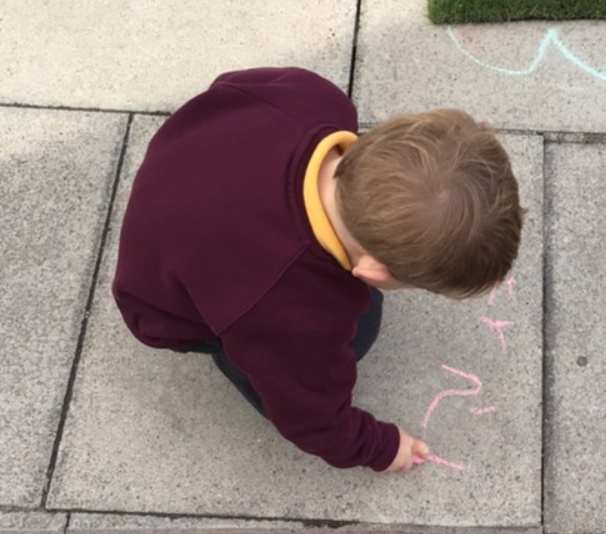
Our learning environment gives our youngest children plenty of opportunities to practise and hone their gross and fine motor skills and writing is therefore delivered through a balance of teaching and exploration of the indoor and outdoor provision. We have carefully designed our Foundation and Year 1 classrooms to provide equipment to work and play on that develops both fine and gross motor skills so that children's ability to hold tools like pencils grows over time.
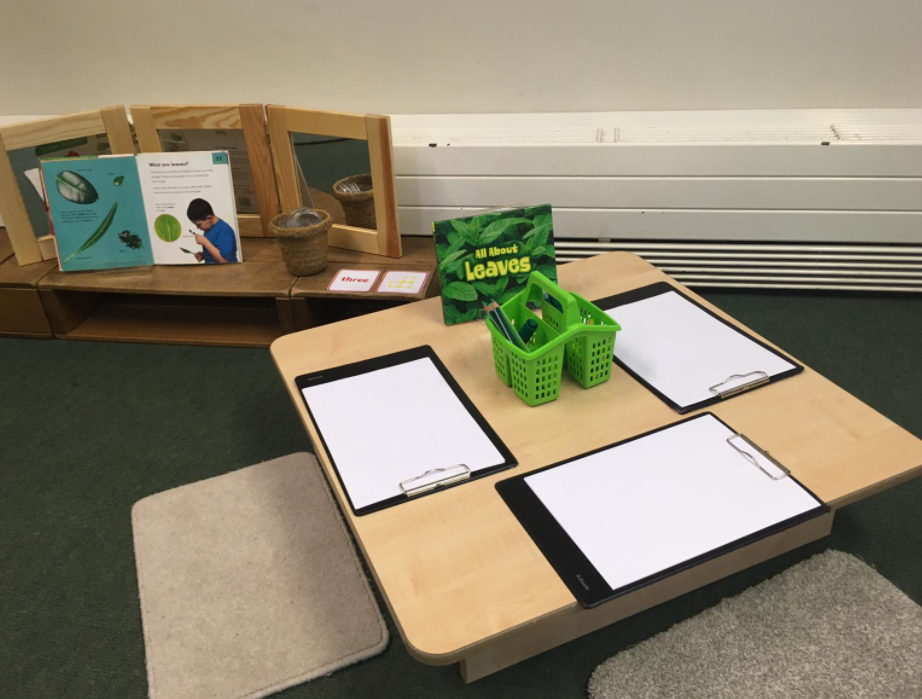
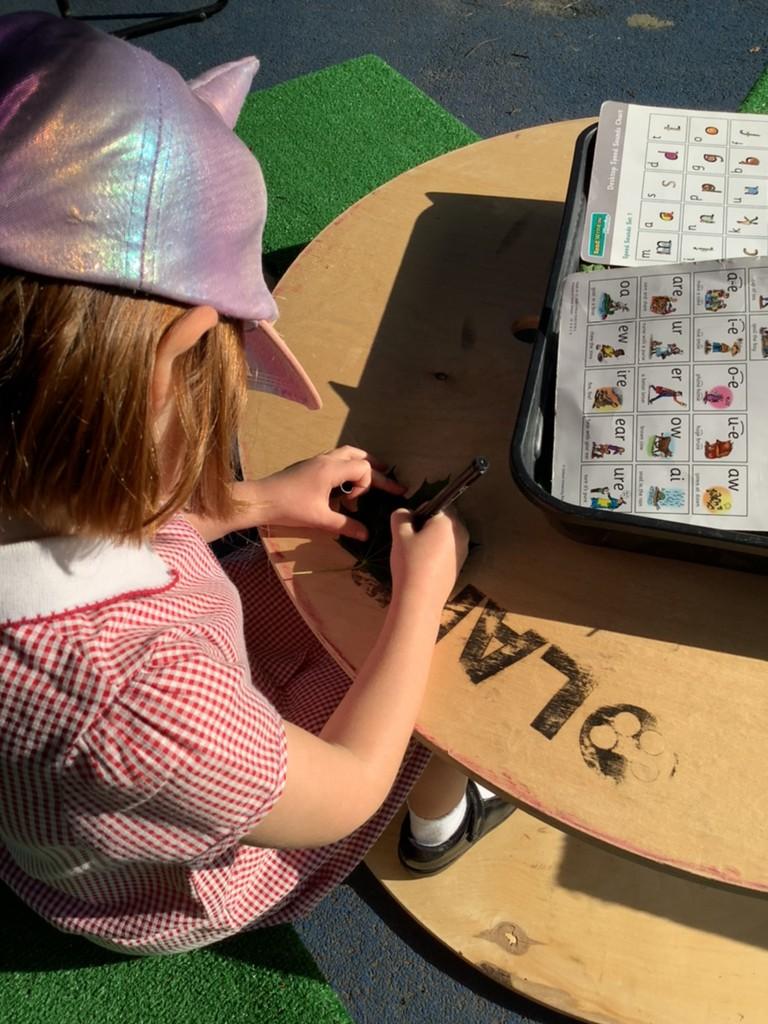
Children's writing is linked to the sounds that the children are learning in the Read, Write, Inc programme. The children write every day, rehearsing out loud what they want to say, before spelling the words using the graphemes and ‘tricky’ words they know.
They practise handwriting every day: sitting at a table comfortably, they learn correct letter formation and how to join letters speedily and legibly.
Children’s composition (ideas, vocabulary and grammar) is developed by drawing on their own experiences and talking about the stories they read.
By the end of Key Stage 1, we aim for each child to be able to write legibly, fluently and at reasonable speed. We do this using the Nelson Handwriting script to ensure consistency and progression.
In the first instance, children are taught the rules for good posture and pencil grip:
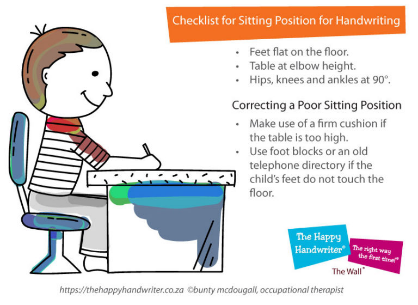
Position
Feet flat on floor
Table at elbow height
Hips, knees and ankles at 90 degrees
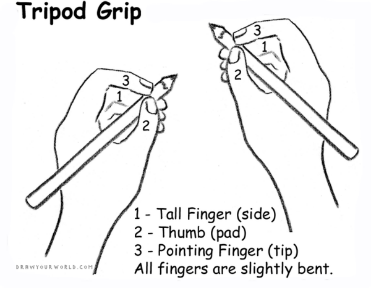
Pencil grip
Children are taught to use a tripod grip.

Paper position
Children are taught to turn their paper at the correct angle depending on whether they are left or right handed.
Impact: how is English enriching the learning of our children?
Children at Market Weighton Inafnt School leave us as confident speakers and listeners. This can be seen in our end of year concerts when children put on a vibrant and entertaining production for their parents. They are all enagaged in lessons and well-prepared for Year 3 at the Junior School. They can use the spoken language effectively to support their own learning and to explain their ideas.
Whilst in Foundation, children read to word build, in Year 1 they read for fluency, so that by the time they reach Year 2, they can add in the third dimension of expression and understanding. Our Year 1 and Year 2 children like to ‘show off’ their proficiency by coming to read a favourite book to our Foundation children in our classroom reading cubes.
Children in Key Stage 1 are well prepared to write because of the how well children in the early years develop their understanding of applying their phonic knowledge to segmenting sounds for spelling. Teachers make sure that children are taught how to ‘think it, say it, write it’ before they begin any writing and they practise ‘holding a sentence’ in their head as a precursor to any writing.
Children are proud of their work on display around the school. Evidence of their writing can be found in all classrooms in a variety of forms from labelling a picture, or explaining mathematical concepts, to writing facts about a science experiment or detailing what they have found out from a visitor to school.
Strong cross-curricular links enable children to apply the skills they have learnt in English to other subjects such as history, geography, science, DT and computing.
Staff Training
In September 2021, all teaching staff (both teachers and teaching assistants) renewed their Read, Write Inc. training and have access to the training portal to enable them to upskill their knowledge in teaching systematic synthetic phonics. This has made the profile of teaching phonics high which is reflected in the outstanding quality of phonics lessons being taught throughout the school.
Wherever possible, our teachers are engaged in discussion of what constitutes high quality teaching and learning in English. These discussions are set within a practical context of real work children will be engaged in so that principles emerge from practice and can then be applied to other contexts. Time is provided for staff to work together on planning and curriculum development.
Next steps
To continue to implement the new Read, Write, Inc programme into our classrooms.
To monitor and evaluate the impact of our latest Read, Write Inc.staff training on reading and writing standards.
To work in partnership with parents by supporting them to use the new Read, Write Inc. "Book Bag Books" at home with their children.