“Geography underpins a lifelong ‘conversation’ about the earth as the home of humankind.”
Geography Association
This area of our curriculum is led by Mrs Randle. Her role is to provide the professional leadership and management for geography to secure high-quality teaching, effective use of resources and improved standards of learning and achievement for all pupils. Mrs Randle has been leading this area of the curriculum since September 2022. She says:
“At Market Weighton Infant School we believe the teaching of geography should inspire in children curiosity and fascination about the world and its people. Geography provides a means of exploring, appreciating and understanding the world in which we live. Geography stimulates curiosity and imagination and we aim to build upon the child’s ‘personal geography’ by developing geographical skills, understanding and knowledge through studying places and themes. Our children will be encouraged to learn through experience particularly through fieldwork and practical activities. Children’s enthusiasm and motivation in geography is high."
The key elements of the National Curriculum's programme of study for geography have been organised into a set of hierarchical statements to ensure that children accumulate more and more geographical knowledge as they progress from our Nursery or Reception through to the end of Year 2. Teachers are aware that planning must always have an eye on longer-term learning and the part that geographical knowledge building plays in this.

|
Progression in geography | [pdf 175KB] |

|
|
|
National Curriculum - Geography key stages 1 to 2 | [pdf 99KB] |
|
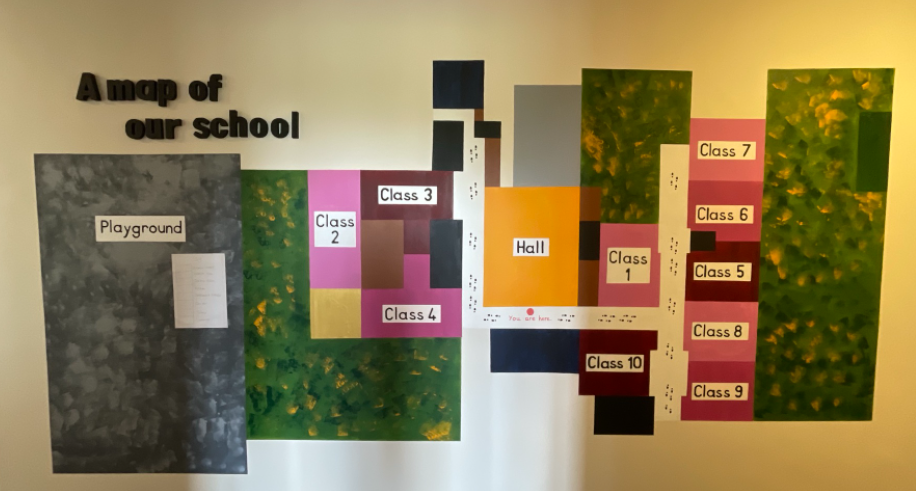
Children use this map to find their way around the school building.
Intent: what do we want children to know about geography by the time they leave our school?
We believe that helping children to take their first steps into the intriguing world of geography can help our children to achieve our school’s core purpose:
To help children to do today what they will be able to do independently tomorrow by becoming confident, successful life-long learners and responsible citizens.
Aspiration: running through all of our geography work is the idea that we are inspiring our children to deepen their knowledge about their world, both physical and human, so that they can take an active part in contributing to and protecting this world as they grow up.
Independence: through the understanding of maps and features of the environment, children are encouraged to work together in teams and share personal experiences to gain a better understanding of their local area and beyond. Children practise and progress in skills and knowledge, raising confidence and growing in independence to be able to collect, interpret and communicate geographical information in a variety of ways.
Motivation: we aim to develop children’s motivation and to capture children’s interest in geography so that they develop an awareness and an interest in the world around them. We want them to ask interesting questions and find out information their immediate surroundings through fieldwork as well as other important sources, such as quality literature.
Aims of teaching geography
- to foster in children the curiosity and fascination about the world and its people that will remain with them for the rest of their lives;
- enable children to develop their knowledge about the world, the UK and their locality;
- to develop geographical vocabulary relating to human and physical features in their locality, UK and the wider world;
- to begin to use their geographical skills, including first-hand observations in order to enhance their local awareness.
Links with British values and PSHE (Personal, Social & Health Education)
Our geography curriculum offers an excellent context for developing many of the worthwhile skills and understanding that are intrinsic British values and form part of the PSHE curriculum. It provides opportunities to for our children to begin to understand.
Democracy
- Children are encouraged to work as a team, considering the views of others
The Rule of Law
- Acquiring an understanding of health and safety, responsibility and quality control
Individual Liberty
- Working within boundaries to make safe and individual choices
Mutual respect
- To behave appropriately allowing all participants the opportunity to work effectively
- To review each other’s work with respect
- Support, help and advise others
Tolerance of those of different faiths and beliefs
- Experience and talk about different cultures and different religious beliefs
- Use geography to learn about different faiths and cultures

Implementation: how is geography being delivered?
Choice of content
Our geography curriculum is conducted through a range of creative and practical activities designed to:
- Enhance awareness of their local natural and built-up environment
- Develop a sense of place
- Understand human impact on the natural environment
- Develop fieldwork and observational skills
- Introduce key knowledge and geographical vocabulary
We follow the Statutory Framework for the Early Years Foundation Stage (September 2021) and the programmes of study in the National Curriculum (2013) for Geography which provides us with the flexibility in the geography we teach.
Geography is used as a stimulus for the teaching of other subjects, such as history, art, science and design and technology.We make sure that geography sits securely within our topic-based approach to teaching the curriculum. Several topics have a geography focus, and in addition to this there are whole school topics of interest which provide in-depth explorations into how geography affects our lives. This ensures that the breadth of geographical coverage matches the aims of the National Curriculum.

Sorting landmarks
Here a child sorts landmarks of Market Weighton according to physical and human features.

Weather
Here a child uses symbols to describe the weather.

Using a map
Here children use a map to find out where a squirrel might build a drey.
Progression in geography
As children move through the school, teachers choose relevant topics and plan their activities carefully so that children’s learning is progressive. In geography, we have taken key elements of the National Curriculum and organised them into a set of hierarchical statements. This makes expectations of progression very clear to teachers when planning lessons. These are:
Progression in locational knowledge
Progression in place knowledge
Progression in human & physical geography
Progression in enquiry and investigation
Progression in fieldwork
Progression in sources and information
Progression in communication
Progression in maps
|
|
Progresion in geography at Market Weighton Infant School | [pdf 177KB] |
|
| This document explains what your child will learn in geography in each year group as they move through the school. |
Helping children to remember their learning and make links
We want our children to be able to remember what they have been taught and be able to make some basic links with their subsequent learning. With this in mind, teachers carefully plan geography lessons using a range of high-quality strategies:
- Activities that specifically emotionally and intellectually engage our children are planned and delivered for the learning to go deep. For example, follow a string trail supported with a map around the school grounds to develop locational and directional language to describe the features and routes on a map.
- Activities that are practical and enable children to apply their knowledge and understanding. For example, Year 1 children make a ‘treasure island’ shape in the outdoor area using sticks, rope or chalk and add objects before drawing a map of it and creating a key.
- Children are challenged to think and to care so that they can express their personal opinions about human impact on the natural environment.
- For children who find learning more challenging, teachers use a whole range of strategies to help engage them in geography. This is personalised according to the individual needs of the child. When children fall behind, they are quickly brought up to speed by well-trained teaching assistants or timely intervention from their teachers.
Staff Training
Wherever possible, our teachers are engaged in discussion of what constitutes high quality teaching and learning in geography. Time is provided for staff to work together on planning and curriculum development. The profile of geography is kept high in the school through a rolling programme of topics, inspiring books and interesting displays that show the high quality of the children’s work.
Impact: how is geography enriching the learning of our children?
The geography curriculum is ambitious and matches the breadth of the national curriculum. Activities are engaging and well planned. Conversations with children show that they are interested in the way geography impacts our lives
Foundation stage
In the Foundation Stage, children learn about their immediate locality so that they know about places in and around our school and school grounds. They have a good understanding of familiar features such as houses, farm and shop buildings as well as a growing knowledge of distant places that they encounter through topics and stories. The children observe and discuss the weather regularly, becoming familiar with types of weather and how it can affect us such as needing coats when it is cold. The children also learn about the different jobs which people do in our community.
Key Stage One
In Key Stage 1, children focus on the local area. They go out in the local area and investigate human and physical geographical features. We are lucky that within a 15 minute walk from school all of these features are available to them and children can name shops, different types of housing, woodland, stream, bridge, church, town centre, library, fields, roads, paths, street signs, post box, junior school, primary school, high school, traffic lights and elderly people’s homes.
Children can talk about contrasting distant localities such as Australia, the USA or Spain and other places through stories and topics. They can use globes and maps to identify the countries of the UK and their capital cities. They can make maps and learn from many secondary sources. They can observe and record the weather and changing seasons.
In Year 2, children can contrast a different locality with their own local area. They can make judgements about places saying what they like and don’t like about different localities. They learn about the beaches and their environmental problems. During the year they visit Bridlington, a place on the coast, and contrast the geography of that place with our local area. Maps, atlases and globes are used throughout the year and children develop their skills using these. Children have opportunities to research places using the computer, iPads, books, pictures and photographs.
Our school environment encourages interest in the world around us. We have a floorplan of the school displayed for children to become familiar with. We have a giant UK and world map displayed around our building which children use to increase their knowledge.
Pupils with special educational needs and/or learning disabilities and lower-attaining students made good progress as a result of the good individual support they receive.
Children can use this huge world map to locate different continents and countries.

Our next steps
- Continue to develop topics to ensure progression and enable children to make links and connections in their learning.
- Continue to develop the use of outdoor learning opportunities in our topic work.
- Continue to develop “knowledge organisers” for geography topics. This is a go-to document which identifies the key information that children need to have learned by the end of a topic. It also acts as a tool to support parents in understanding coverage and helps children in retaining and retrieving knowledge for life-long learning. Each one starts with knowledge children should already know from previous learning and what the links are with future learning.