Physical Education (PE)
"Intelligence and skills can only function at the peak of their capacity when the body is healthy and strong".
John F. Kennedy
This area of our curriculum is led by Mrs Oliver. Her role is to provide the professional leadership and management for PE to secure high-quality teaching, effective use of resources and improved standards of learning and achievement for all pupils. Mrs Oliver has been leading this area of the curriculum since 2017. She says:
“Our PE curriculum genuinely excites our children’s creativity and independence in demonstrating key skills in physical education. Our younger children begin by learning the fundamental skills in becoming independent with their own health, self-care and physical skills. Teachers carefully shape children’s learning in order for them to develop an awareness of their abilities relating to physical activities. Our older children begin to use their own creativity and independence to explore their physical abilities and how far they can stretch themselves. Giving the children the independence to explore at their own pace and levels allows for the love of sport to grow as it is not pressurised. Children’s motivation in PE is high and the quality of skills they develop is good.
A high quality PE curriculum can also inspire pupils to succeed and excel in competitive sport and other physically demanding activities. We will endeavour to provide opportunities for pupils to participate in competitive sports and activities both in and beyond the curriculum. This will mean that all pupils have the opportunity to participate in regular competitive sport."
The key elements of the National Curriculm's programme of study for PE have been organised into a set of hierarchical statements to ensure that children accumulate more and more knowledge they progress from our Nursery or Reception through to the end of Year 2. Teachers are aware that planning must always have an eye on longer-term learning and the part that knowledge building plays in this.

|
Progression in Physical Education | [pdf 190KB] |

|
|
|
National Curriculum - Physical education key stages 1 to 2 | [pdf 89KB] |
|
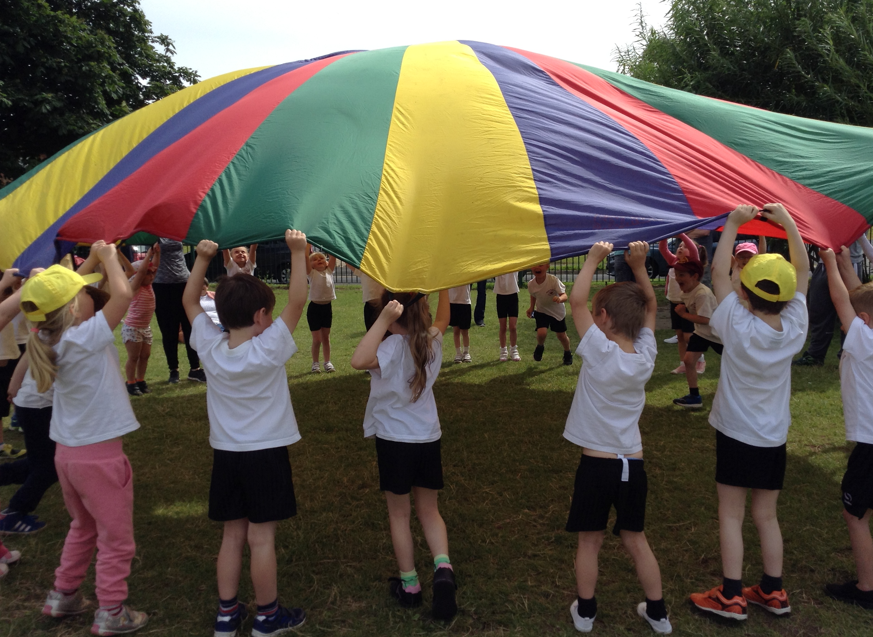
Y1 children work the arms, shoulders and torso in a co-operative team game with a parachute.
Intent: what do we want children to know about PE by the time they leave our school?
We believe all children should have access to a high quality Physical Education (PE) curriculum and PE should be an integral part of the whole school curriculum. Our school recognises the benefits high quality PE provision and school sport can give to all pupils. Our bespoke PE curriculum aims to ensure that all pupils develop physical literacy and the fundamental knowledge, understanding and skills to excel in a wide range of physical activities by providing a broad & balanced curriculum with opportunities for all. Our PE curriculum contributes to healthy and active lifestyles, improves emotional well-being, reduces challenging behaviour, increases attendance and develops key skills such as leadership, confidence, creativity, independence and social and team building skills.
PE produces young people with the skills, understanding, desire and commitment to continue to improve and achieve in a range of PE, sport and health-enhancing physical activities in line with their abilities
How does PE contribute to this? To us, PE encourages pupils to be active and supports them in their understanding of how to participate safely and effectively. Our PE curriculum is inclusive to ensure that pupils of all abilities access the range of activities on offer and that they are physically active for sustained periods of time in order to encourage them to lead healthy, active lives. Regular participation in sport and physical activity can help to reduce the risk of heart failure, improve physical fitness, help with weight management, promote good health, instil self-discipline, develop skill, improve self-confidence, reduce stress and develop lifelong learning skills.
For our very youngest children, it is about them developing an understanding of their bodies.
Aspiration: we want our children to develop the love of sport and to aspire to be the best that they can.
Independence: children are taught a range of skills over time to help them to develop independence in practising and demonstrating key physical skills.
Motivation: we aim to develop children’s motivation and to capture children’s interest in PE so that they develop awareness and an interest in sport and physical activities. They will be able to use the multi-skills that they are taught in a range of competitive sports. Children will also begin to learn about team work and competitive sportsmanship.
Aims of teaching PE
- to develop competence to excel in a broad range of physical activities
- to be physically active for sustained periods of time
- to engage in competitive sports and activities
- to lead healthy, active lives.
Links with British Values
Our PE curriculum offers an excellent context for developing many of the worthwhile skills and understanding that are intrinsic British values and form part of the PSHE curriculum. It provides opportunities for our children to begin to:
1. Practise working cooperatively and make decisions.
2. Understand how to win and lose fairly and understand good sportsmanship.
3. Learn to work individually and in groups.
4. Compete against themselves in addition to competiting against others.
5. Recognise individual differences.
6. Learn about historical and cultural differences through a variety of PE activities.
7. Learn about the environment and different activity contexts.

Implementation: how is PE being delivered?
At Market Weighton Infant School,
We teach lessons so that children have fun and experience sporting success. Children are all given the opportunity to join in with PE at their own level of development. They develop a good understanding of basic rules and are able to build up and secure a range of skills. They develop good sporting attitudes and experience positive competition. They are able to learn and develop their sporting skills in a safe environment. Finally, they are given the foundations for lifelong physical activity, leaving our school as physically active.

In the Foundation Stage, children are introduced to "Jump Start Jonny". These are fun workouts and chill-out videos that help children keep fit and improve mental well-being. The videos are around 5 minutes long and use songs that the children are familiar with and enjoy. They can be used as a brain break if the children are becoming fidgety and need a bit of time out. There are relaxation videos and scripts that can be used at any time of the day in the classroom. The children love and enjoy taking part and dancing along with Jonny.
Children take part in "Cosmic Yoga" which helps build strength, balance and confidence. We believe that it's never too early to introduce childen to the physical benefits of yoga as well as the mental, emotional and social benefits.

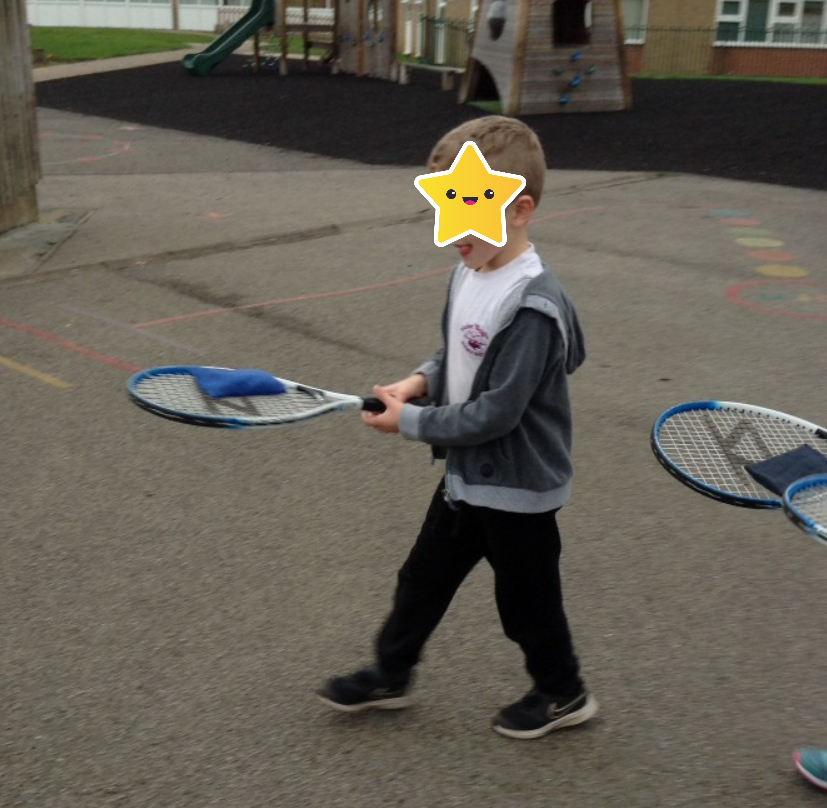
We offer a range of extra-curricular clubs that children can join at the end of the school day. These include golf, tennis, football and yoga. Children can use these sessions to improve their skills to really practise their skills and develop their potential.
Helping children to remember their learning and make links
We want our children to be able to remember what they have been taught and be able to make some basic links with their subsequent learning. With this in mind, teachers carefully plan their PE lessons using a range of high quality strategies:
- Retrieval practice is at the heart of each lesson and provides the opportunity to recall previously taught knowledge. Through enabling knowledge to stick, this allows children to build secure understanding in PE.
- Teachers recognise the effort and work of every child so that they have self-belief in their own ability and progress.
- Children are given a sense of autonomy and control within agreed boundaries. For example, by giving them a choice (on equipment, pace, direction, how to move, when to move on, activity, challenge etc.); empowering them to work collaboratively to solve a problem that has been set; or even enabling them to coach and support others.
For children who find learning more challenging, teachers use a whole range of strategies to help engage them in PE. This is personalised according to the individual needs of the child. The language and environment are inclusive and make every child feel valued. There is a clear focus for learning which every child feels is achievable and relevant; every child can access all parts of the lesson and praise is predominantly based around positive behaviours and progress.
Impact: how is PE enriching the learning of our children?
P.E is taught as a basis for lifelong learning, where the children have access to a wide range of activities in the belief that if taught well and the children are allowed to succeed, then they will continue to have a physically active life. A high-quality physical education curriculum inspires all children to succeed and excel in competitive sport and other physically-demanding activities. At Market Weighton Infant School, we provide opportunities for children to become physically confident in a way which supports their health and fitness. Opportunities to compete in sport and other activities build character and help to embed values such as fairness and respect.
In the early years, our children begin to learn basic movements and in Year 1 they learn how to move with control and care. Older pupils then extend this skill to developing good control and coordination. Teachers carefully support the children through this progression offering careful support and guidance.
Children are proud of their work and the skills that they are demonstrating and are keen to show their friends what they can do.
Teachers explain the lesson content clearly. This helps pupils, and particularly disadvantaged pupils and pupils with special educational needs and/or disabilities (SEND), to improve their use of PE vocabulary and remember more over time. Teachers’ careful consideration of how to adapt activities ensures that pupils with special educational needs and/or disabilities (SEND) access the PE curriculum fully.
We have been fortunate to be able to develop our school grounds over the course of several years so that children have access to outdoor space and a range of challenging physical activities. As a result, children are physically active and have the opportunity to develop gross motor skills on a daily basis.
Children’s participation in PE and other physical activities is very strong. They have lots of opportunities to practise and demonstrate the skills they are learning. For example, they have the opportunities to show during the lessons where they are able to talk about what they did well and how they could improve next time. Children go on to enjoy PE and take pat in competitive inter-school sport when they move into Key Stage 2.
Monitoring and Assessment
PE lessons are monitored by the PE leader through lesson observations and our online Tapestry record system. Teachers assess pupils’ understanding of key concepts in PE well. They check their knowledge and understanding through questioning pupils during lessons, observing practical sessions and asking pupils to explain their answers or reasoning. Consequently pupils are increasingly well prepared to develop their understanding in Key Stage 2. Pupils take their enthusiasm for PE into Mount Pleasant Junior School and beyond.