Religious Education (RE)
"Reaching for the world as our lives do,
As all lives do, reaching that we may give
The best of what we are and hold as true:
Always it is by bridges that we live."
Philip Larkin: Bridge for the Living, 1981

This area of our curriculum is led by Miss Hull. Her role is to provide the professional leadership and management for religious education to secure high-quality teaching, effective use of resources and improved standards of learning and achievement for all pupils. Miss Hull has been leading this area of the curriculum since September 2023. She says:
“Market Weighton Infant School recognises and values the religious backgrounds and non-religious backgrounds of each of our pupils. We intend to be sensitive to the home background of all and therefore work to ensure that RE is accessible to all pupils and teachers of any religious persuasion or none. The school is not affiliated with any particular religious denomination but is broadly Christian. We are legally obliged to teach R.E. The school’s Religious Education curriculum therefore follows the guidelines given in the East Riding’s Agreed Syllabus and aims to develop the child’s knowledge about religious experiences, customs, places, people and artefacts connected with religious lifestyles. Our curriculum offers bridges to our rich, local cultural and faith heritage. This begins right from the early years when children ask questions about themselves and their own families and develop a sense of place in their own family and community. We support children to reflect on their own beliefs, culture and faith and those of others in lots of different ways such as stories, drama, art, dance, visual artefacts and visits to local places of worship. By the time they leave our school children begin to become sufficiently confident in their own beliefs and values that they can respect the religious and cultural differences of others, and go on to contribute to a cohesive and compassionate society.”
The key elements of the East Riding's Agreed Syllabus for RE have been organised into a set of hierarchical statements to ensure that children accumulate more and more knowledge as they progress from our Nursery or Reception through to the end of Year 2. Teachers are aware that planning must always have an eye on longer-term learning and the part that kowledge building plays in this.

|
Progression in RELIGIOUS EDUCATION (RE) | [pdf 275KB] |

|
|
|
Religious Education Policy | [pdf 118KB] |
|
|
|
2022 Agreed Syllabus | [pdf 881KB] |
|
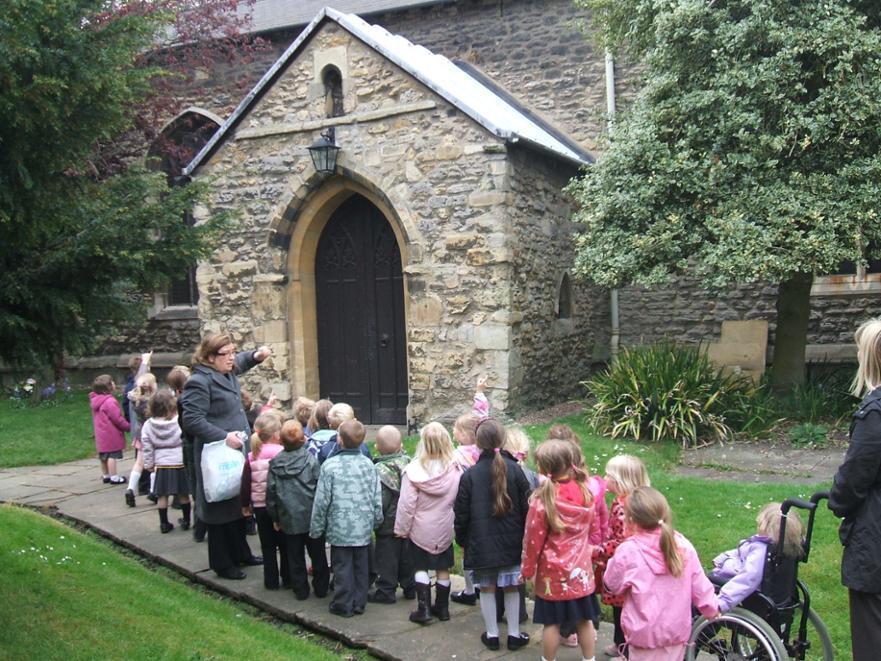
Here you can see some of our children visiting All Saints Church in Market Weighton to find out more about places of worship.
Intent: what do we want children to know about Religious Education by the time they leave our school?
Aims of teaching religious education
We believe that helping children to take their first steps into the fascinating world of Religious Education can help our children to achieve our school’s core purpose:
To help children to do today what they will be able to do independently tomorrow by becoming confident, successful life-long learners and responsible citizens.
How does Religious Education contribute to this?
For our very youngest children, it is about them developing an understanding of who they are and where they have come from. For our oldest children, it is about developing some basic skills that will help them to know more about their own beliefs, culture and faith and those of others. This will help them to become the successful learners and responsible citizens of tomorrow. This grounding in the study of religious education will give them a firm foundation for their learning at Key Stage 2 and beyond.
Aspiration: we want our children to develop a curiosity about themselves and their beliefs and provide them with the aspiration to go on to learn more about religious education in their future schooling so that they can investigate and reflect on fundamental questions. We want them to develop an understanding of religious traditions and to appreciate cultural differences.
Independence: children are taught a range of skills over time to help them to explore their own beliefs and thinking and to build their own sense of identity and belonging. They learn appropriate vocabulary that will help them to explore religious ideas and respect for others. We want them to see how they can contribute to their own community and wider society.
Motivation: we aim to develop children’s motivation and to capture children’s interest in religious education so that they develop an awareness and an interest their own beliefs, culture and faith and those of others, including Christianity and other worldviews.
We believe at this school that Religious Education both supports and strengthens what we aim to do in every aspect of school life. Our caring ethos and the value which we place on the development of the whole child is reflected in our Religious Education curriculum.

Links with British values
Our Religious Education curriculum offers an excellent context for developing many worthwhile skills and understandings that are intrinsic British values. It provides opportunities for children to begin to:
- Practise working cooperatively and making decisions.
- Understand democracy in classroom contexts.
- Learn to work individually, in pairs and in groups.
- Preparing to play an active role as citizens.
- Develop good relationships and respecting the differences between people and their opinions, including those of different faiths and beliefs.
- Make connections between cause and consequence.
- Develop ethical and personal values.
Our Religious Education curriculum offers an excellent context for developing many of the skills of PSHE. It provides opportunities for our children to experience:
Spiritual development
- Use imagination and creativity to explore ideas.
- Develop fascination and curiosity in the work of others.
- Be reflective about their own beliefs and perspectives.
Social development
- Collaborate to create work and solve problems.
- Respect each other’s ideas, opinions, beliefs and faiths.
- Consider the views of others.
Cultural development
- Understand and appreciate a wide range of cultural influences.
- Recognise and value the things we share in common across cultural and religious communities.
- Participate in artistic, musical, sporting and cultural events and opportunities.
Moral development
- Recognise the difference between right and wrong.
- Understand rules and legal boundaries
- Appreciate the consequences of their behaviour and actions
Progression in RE
As children move through the school, teachers make subject sensitive decisions (led by the RE subject leader) about what is taught in RE to enable pupils to build forms of knowledge distinctive to RE. The curriculum lays the journey for what it means to get better at RE. Our progression map sets out an ambitious curriculum for RE, making expectations very clear to teachers when planning their RE lessons.
|
|
RE Curriculum Progression Map | [pdf 275KB] |
|
Implementation: how is Religious Education being delivered?
Standing Advisory Council for Religious Education (SACRE) recommends a minimum of 5% of curriculum time to provide sufficient time to fulfil the requirements of the locally Agreed Syllabus. We are aware of cross curricular links and the place of collective worship and festival celebrations in enhancing our delivery of religious education. We refer to the statutory fields of enquiry when planning our units of work.
- Our teaching enables children to extend their own sense of values and promotes their spiritual growth and development. We encourage children to think about their own views and values in relation to the themes and topics studied in the RE curriculum.
- Our teaching and learning styles enable children to build on their own experience and extend their knowledge and understanding of religious traditions.
- Christianity is given more than 50% teaching time, with Judaism, Humanism and other worldviews explored when appropriate.
Planning and Delivery
Most Religious Education provision in the early years (Foundation Stage) is integrated within the Foundation Stage curriculum, as opposed to a stand-alone subject. This is mainly within the area of learning known as "Understanding the World". In Key Stage 1, the Religious Education curriculum is based on three areas of learning from the East Riding Agreed Syllabus:
THEOLOGY: the study of religion- from the Greek “theos” (god) and “logia” (saying or utterances)- “words of god”. Theology is about BELIEVING, asking questions about the concept and nature of god, where beliefs come from, and about sources of information and influence.
PHILOSOPHY: how and why people do certain things- from Greek “philo” (love) and “sophos” (wisdom)- the love of wisdom. Philosophy is about THINKING, asking questions about morality and ethics, about the nature of reality and what it means to be human.
SOCIAL SCIENCES: understanding and analysing the part that religion plays in the lives of people, communities and societies. Social Sciences are about LIVING, asking questions about the influence of religions and beliefs on individuals, communities, culture and how people live their lives.
Helping children to remember their learning and make links
We want our children to be able to remember what they have been taught and be able to make some basic links with their subsequent learning. With this in mind, teachers carefully plan RE lessons using a range of high-quality strategies:
- Activities that specifically emotionally and intellectually engage our children are planned and delivered for the learning to go deep. For example, exploring a range of Christian artefacts to engage the children in asking “big questions” about what they are, drawing on previous learning.
- Activities that are practical and enable children to apply their knowledge and understanding. For example, visiting a local church to investigate worship.
- Children are challenged to think and to care so that they can express their personal opinions about their own beliefs and those of others.
- For children who find learning more challenging, teachers use a whole range of strategies to help engage them in Religious Education. This is personalised according to the individual needs of the child. When children fall behind, they are quickly brought up to speed by well-trained teaching assistants or timely intervention from their teachers.

Assessment and Recording
Assessment is carefully matched to the curriculum. Records of the children's work in RE are kept on our school's online learning journal, "Tapestry". We provide an annual report to parents or carers giving brief particulars of progress and achievements in RE.
Resources
Children have access to a wide variety of resources including books specifically designed to develop young children’s religious literacy, persona dolls, artefacts, posters and visits to local places of worship. We encourage children and visitors to share experiences of their faith.
Staff Training
Wherever possible, our teachers are engaged in discussion of what constitutes high quality teaching and learning in Religious Education. Time is provided for staff to work together on planning and curriculum development. The profile of Religious Education is kept high in the school through a rolling programme of topics, inspiring books and interesting displays that show the high quality of the children’s work.
Withdrawal from Religious Education
This was first granted in 1944 when curricular RE was called ‘Religious Instruction’ and carried with it connotations of induction into the Christian faith. RE is very different now – open, broad and exploring a range of religious and non-religious worldviews. In the UK, parents still have the right to withdraw their children from RE on the grounds that they wish to provide their own RE. This provision will be the parents’ responsibility. This right of withdrawal exists for all pupils in all types of school, including schools with and without a religious designation. Parents also have the right to withdraw their child from part of RE, and can do so without giving any explanation.
Teachers also have the right to withdraw from the teaching of RE. However, this does not apply to teachers who have been specifically employed to teach or lead RE. If a teacher wishes to withdraw from the teaching of RE, a letter requesting this must be submitted to the head of the school and its chair of governors. If a teacher withdraws from the teaching of RE, the school must still make provisions for the pupils to receive their entitlement to RE.
|
|
Guidance- dealing with withdrawal from RE | [pdf 3MB] |
|
Impact: how is Religious Education enriching the learning of our children?
The impact of our RE curriculum is measured through our monitoring cycle, which includes Tapestry reviews, book scrutinies, learning walks, pupil and staff voice, planning scrutiny and curriculum intent reviews. Upon review, the subject leader agrees and formulates an action plan for improvement.
The intended impact of our RE curriculum is outlined below:
By the end of Key Stage 1 (Year 2), pupils should be able to:
- retell and suggest meanings for some religious and moral stories and say how they influence people today
- recall different beliefs and practices, naming key words, key figures and core beliefs
- tell of the ways people express identity in belonging to a faith group, and show how they are similar to another faith group
- talk about what happens in places of worship and describe how symbols and artefacts are used in each, appreciating some similarities and differences
- consider and make responses to big questions from different worldviews
- express ideas and opinions about moral questions of right and wrong
- share ideas and examples of co-operation between people who are different
- describe what happens at festivals, ceremonies and rituals and talk about the beliefs behind them
From example, when learning about different Christian artefacts, children showed their knowledge (criteria 4 above) by making different comments such as:
“the cross shows God’s love”.
“Jesus was in Mary’s tummy” (referring to a statue of Mary)
“a candle in church makes you think of hope and God.”