What are SATS?
SATS stands for Standard Assessment Tests. SATS are administered by primary schools and measure children’s educational achievement in years 2 and 6. They hold schools to account for the attainment of their pupils and the progress they make. In our school, children complete their SATS in Year 2 during May. They test children’s ability in maths and reading. The tests are informal, so they aren’t timed and they take place in a normal classroom situation. From 2024, they will be made non-statutory, so schools will choose whether to administer them or not.

|
SATS information letter for parents | [pdf 206KB] |

|
| If you couldn't make our meeting about SATS in March, please read through this letter about SATS. |
The reading test
The reading test for Year 2 pupils is made up of two separate papers:
- Paper 1 consists of a selection of texts totalling 400 to 700 words, with questions interspersed
- Paper 2 comprises a reading booklet of a selection of passages totalling 800 to 1100 words. Children will write their answers in a separate booklet
Each paper is worth 50 per cent of the marks, and should take around 30 minutes, but children are not strictly timed, as the tests are not intended to assess children’s ability to work at speed. The texts in the reading papers cover a range of fiction, non-fiction and poetry, and get progressively more difficult towards the end of the test.
Teachers have the option to stop the test at any point that they feel is appropriate for a particular child.
The maths test
The Key Stage 1 maths test is made up of two papers:
- Paper 1: arithmetic, worth 25 marks and taking around 15 minutes.
- Paper 2: mathematical fluency, problem-solving and reasoning, worth 35 marks and taking 35 minutes, with a break if necessary. There are a variety of question types: multiple choice, matching, true / false, constrained (e.g. completing a chart or table; drawing a shape) and less constrained (e.g. where children have to show or explain their method).
Children are not allowed to use any tools such as calculators or number lines.

How can I best help my child?
- Continue helping them with their reading homework on a regular basis.
- It would be useful to revise spellings homework and to practise handwriting.
- Make sure your child is not overtired during the two test weeks and try to ensure his or her full attendance during the test weeks and the run up to the weeks.
- You could complete the practice papers available online with your child if you think it will be of benefit or purchase practice books.
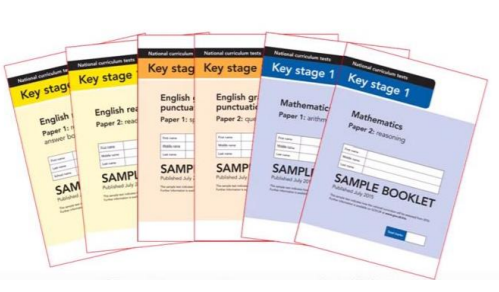
Past test papers
You could complete the maths and reading practice papers available online with your child if you think it will be of benefit or you could purchase practice books.
 |
Past test papers |
| Click here access a range of previous test papers. |
Teacher assessment judgements
When making their teacher assessment judgements, teachers will assess your child’s work against a clearly defned framework.
For English reading, English writing and mathematics, each judgement reports if a pupil is:
• working towards the expected standard (WTS)
• working at the expected standard (EXS)
• working at greater depth within the expected standard (GDS)
For science, the judgement will only report if a pupil is working at the expected standard (EXS) or has not met the expected standard (HNM).
What is my child expected to know and do by the end of Year 2?
Click on the links below to find out more about the expectations for children at the end of Year 2.
|
Teacher assessment frameworks at the end of key stage 1 |
| Find out more about what your child is expected to know by the end of Y2 in reading, writing and mathematics. | |
|
Teacher assessment exemplification in science |
| Find out more about what your child is expected to know by the end of Y2 in science. |
Please don’t worry if your child has not reached the ‘expected’ stage for the end of Y2. The last few years have been challenging times for our Y2 children and we are all proud of the progress they have made and the dedication, hard work and effort from each and every one of them, whatever their assessment outcome. We shall pass on their results, individual needs and next steps to the relevant junior school staff.

Further information
If you would like to find out more about the SATS, please browse the links below or speak to your child's class teacher.
|
SATS information for parents from the Standards & Testing Agency |
| This booklet provides further information about the Key Stage 1 tests as well as the Key DStage 2 tests which children complete in Year 6. | |
|
DfE information for parents about SATS |
| This 4 minute video provides more information about SATS. | |
|
2023 Key Stage 1: Assessment & Reporting Arrangements |
| This link takes you to the Standards & Testing Agency site which provides information for teachers about SATS administration. |