Early Years Foundation Stage (EYFS)
“Children learn and develop more from birth to five years old than at any other time in their lives. If children are at risk of falling behind the majority, the best time to help them to catch up and keep up is in the early years. Every child can make progress, if they are given the right support. When we give every child the best start in their early years, we give them what they need today. We also set them up with every chance of success tomorrow.”
Development Matters, 2021
Children in the Nursery (Foundation 1) and Reception (Foundation 2) follow the Early Years Foundation Stage curriculum known as the EYFS Framework. Our Early Years Foundation Stage (EYFS) is led by Mrs Randle. Her role is to provide leadership and management for EYFS to secure high-quality teaching, effective use of resources and improved standards of learning and achievement for all pupils. Mrs Randle has been leading EYFS since September 2017. She says:
“Our Foundation Stage offers a truly exciting start as the children take their ‘first steps’ into the world of education. All our children feel safe, secure and happy in their learning. Teachers know each pupil's individual needs and create accurate targets for them to achieve regardless of the starting point meaning children make sustained progress. Staff are highly motivated and trained to ensure that all children are allowed the opportunity to learn. Within the Foundation Stage, we have created an environment that allows children to feel empowered and independent learners, and to develop skills in a safe and exciting way.
We believe play is essential to childhood. Play is a child's natural means of expression and discovery. When children re-enact their lives in play with others, they grow socially, and their understanding of their world is strengthened. As children climb, jump, build and lift, they learn problem-solving as well as physical skills.”

|
EYFS Policy 2023-2026 | [pdf 143KB] |

|
Curriculum Plans
|
|
F2 Curriculum Plan for Classes 2, 3 & 4 | [pdf 566KB] |
|
EYFS: A Guide for Parents
Want to know more about the Early Years Foundation Stage and what you can do to support your child? Click on the link below to access an accessible guide to help you to find out more about this important stage of your child's life.
|
|
What to Expect in the Early Years Foundation Stage -A Guide for Parents | [pdf 5MB] |
|
Intent
It is our intent that the children who enter our EYFS develop physically, verbally, cognitively and emotionally whilst embedding a positive and enthusiastic attitude to school and learning. We believe that all children deserve to be valued as an individual and we are passionate in allowing them to achieve their full, unique potential as they take their first steps in tomorrow’s world.
Aspiration: We want our children to have the confidence to take risks and become confident, independent learners.
Independence: Children build on what they already know and can do. We encourage a positive attitude and disposition to learn. Our children have opportunities to engage in activities planned by adults and also those that they plan or initiate themselves. Children do not make a distinction between ‘play’ and ‘work’. We understand that children need time to become engrossed, work in depth and complete activities.
Motivation: We aim to develop our children’s motivation to learn by following their interests. Adults ensure they fully understand each child’s likes and dislikes and plan activities and provision that ensure all children can develop their knowledge and understanding and reach their potential.
Choice of Content
The early learning goals (the knowledge, skills and understanding which young children should have acquired by the end of the reception year) and the educational programmes (the matters, skills and processes which are required to be taught to young children) are set out in the ‘Statutory Framework for the Early Years Foundation Stage’. These are broken into Prime and Specific areas:
Prime Areas
Personal, Social and Emotional Development
Communication and Language
Physical Development
Specific Areas
Literacy
Mathematics
Understanding the World
Expressive Arts and Design
We believe these 7 areas to be equally important and depend on each other to support a rounded approach to child development. We aim to deliver all the areas through planned, purposeful play, with a balance of adult-led and child-initiated activities.
Adults allow children time to pursue their own interests. Skilled adults interact at just the right moment, to support and extend children’s learning. This means that children can achieve the maximum progress.
There are no set playtimes in the traditional sense because outdoor play is part of the ongoing curriculum. Children have access to a large range of equipment from the well-resourced sheds and are encouraged to make their own choices as they play. For example, if they notice that a plant is wilting, what could they do about it? If they want to make a boat, what could they use? If they want to clean the shed, what do they need? We have created stimulating environments which are well resourced with open-ended flexible materials that support play and learning across the curriculum. Children can choose, create, change and be in charge of their play.
Areas of learning may be taught through short topics or stories. The children engage in a rich cross-curriculum and creative range of activities. For example, children study the seasons throughout the year and learn about different festivals such as Christmas and Chinese New Year. Some areas of the curriculum are taught as high quality stand-alone differentiated lessons e.g. phonics and maths.
We follow the Read Write Inc phonic scheme in Foundation Stage 1 and 2. Maths is taught using Maths Mastery thinking with staff receiving training from the National Centre for Excellence in the Teaching of Mathematics (NCETM). Procedural fluency and conceptual understanding are developed in tandem as each supports the development of the other. Significant time is spent developing deep knowledge of key ideas that are needed to underpin future learning.
Links with British values and PSHE (Personal, Social & Health Education)
Our Foundation Stage curriculum offers excellent content for developing many worthwhile skills and understanding that are intrinsic British values and form part of the PSHE curriculum.
Children will:
- Play co-operatively, taking turns with others.
- Take account of one another’s ideas when organising their activities.
- Will show sensitivity to others needs and feelings.
- Become confident to speak in a familiar group and share ideas.
- Work as part of a group or class, and understand and follow school rules.
- Adjust their behaviour to different situations, and take change in their stride.
- Know that other children do not always enjoy the same things, and are sensitive to this.
- Know about similarities and differences between themselves and others, among families, communities and traditions.

Implementation
We have a curriculum that is child-centred and that is based upon topics and interests which engage our children. Our children are active learners who are motivated and interested in their learning. We take time to get to know our children’s interests and their likes in order to best support their learning. We ensure a broad, balanced and stimulating curriculum that is personalised to meet individual needs. Each area of learning and development is implemented through planned, purposeful play, and through a mix of adult-led and child-initiated activities, which take place both indoors and outdoors. Practitioners respond to each child’s emerging needs and interests, guiding their development through warm, positive interaction.
Our EYFS curriculum ensures we are able to meet the individual needs of every child within the Foundation Stage. Children have personalised achievable targets to work towards. Adults ensure children are taught the skills needed in order for a child to achieve their targets.
We aim to provide a setting that encompasses a safe and stimulating environment where children are able to enjoy learning and grow in confidence that helps them to develop their potential.
In doing so, we meet the legal requirements for:
- Safeguarding and promoting children’s welfare.
- Providing suitable adults with appropriate qualifications, training, skills and knowledge.
- Maintaining records, policies and procedures for the safe and efficient management of the setting and to meet the needs of the children.
- Planning and organising to ensure that every child receives an enjoyable and challenging learning and developmental experience tailored to meet their individual needs.
Glorious outdoor play! We use the outdoor environment to provide learning opportunities that are not available inside. Being outdoors means that our children can do things on a bigger, grander scale than indoors. Noisy, boisterous and vigorous play is less of an issue when we are outside. Outdoor play can use the nature around us and can be messy!
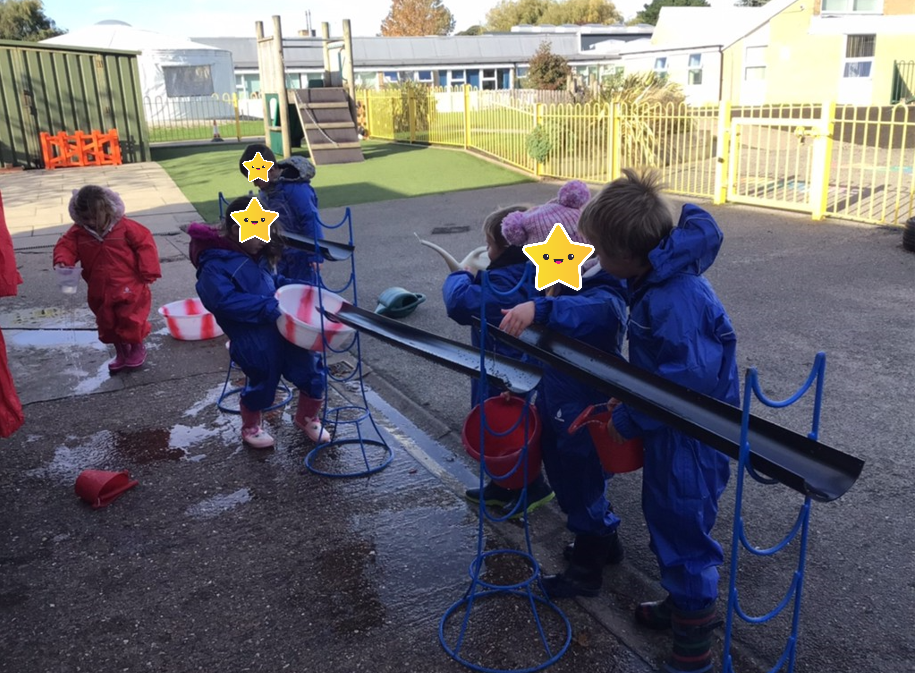

Outdoor play
Here we have a child working out how to use the equipment to build a car.
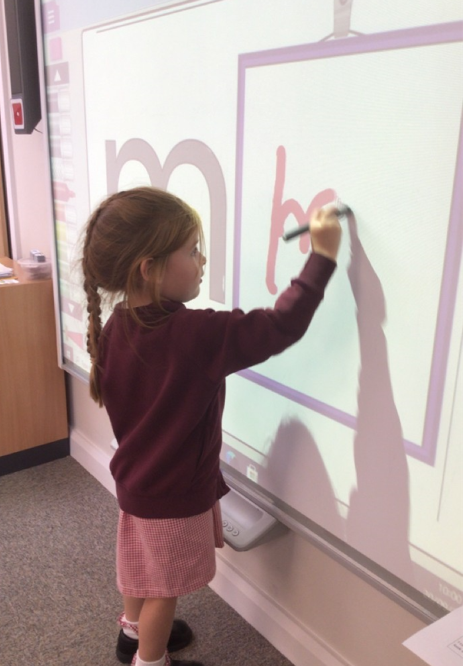
Letter formation
Here we have a child working hard to get her "m" letter just right.
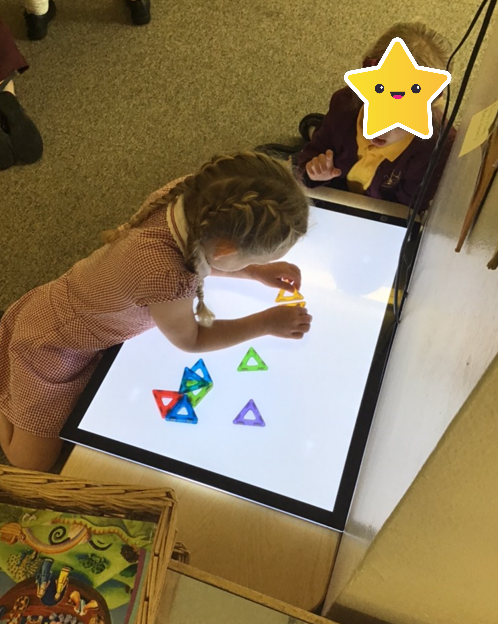
Shape
Here we have children working together with magnetic shapes on a light box to find out about polydrons.
Progression of Skills
Staff use their professional knowledge to help children make progress using up to date guidance such as “Development Matters” in conjunction with the EYFS framework. Development Matters states that:
“Depth in learning matters much more than moving from one band to the next or trying to cover everything. For example, it is important to give a child many opportunities to deepen their understanding of numbers to 5. There is no value in rushing to 10. Children who may struggle in their early learning are not ‘low ability’. We do not know what their potential might be. Every child can make progress with the right support.”
By monitoring each child’s progress closely, staff are able to make the right decisions about what next steps are needed, whether this is extra support as they are at risk of falling behind, or an extension to deepen their knowledge and understanding. As a school we have developed a Progression of Skills map which covers key milestones in each area of learning in the Early Years Foundation Stage. Staff use this as a guide to assist with planning and assessment.
|
|
EYFS Skills Progression | [pdf 182KB] |
|
Staff Training
Staff training is vital in the early years sector to develop knowledge and provide a safe, caring environment for all children. Our EYFS staff are highly trained to ensure they plan, prepare and accurately assess children’s development. Training is updated on a regular basis to develop knowledge and to keep up to date with the latest developments in early years education, whether it is paediatric first aid training, child protection or curriculum-based training. Time is provided for staff to work together to plan and monitor the curriculum and children’s learning. Senior leaders monitor and provide feedback to all staff to maintain high standards of teaching and learning. Whole school training ensures that adults in subsequent year groups (Key Stage 1) are fully aware of the needs and levels of skill of a Foundation Stage child.
Impact
Children demonstrate high levels of engagement in activities, developing their speaking and listening skills, enabling them to access more areas of learning and communicate to both adults and children. Children develop skills across all areas of the curriculum including literacy, mathematics and physical development using these in different ways. They develop a wider sense of the world around them and can draw on these experiences during interactions with others and link this to new learning.
Children develop their characteristics of learning and are able to apply their knowledge to a range of situations, making links and explaining their ideas and understanding. Children are confident to take risks and discuss their successes and failures with adults, drawing on their experiences to improve or adjust what they are doing.
Adults use ongoing assessment as an integral part of the learning and development processes. Adults observe pupils to identify their level of achievement, interests and learning styles. Observations are recorded using “Tapestry”. Tapestry is a secure online learning journal to record our observations of each child to build up a record of their achievements. It runs right across the school to capture their three or four year journey with us. Observations take the form of photographs, videos and comments and are often used to shape future planning. This system enables us to work with parents and carers to share information and take into account observations shared by parents and carers. Parents are provided with their own secure log-in details when their child starts nursery or school.
Children will be actively engaged in learning and their enjoyment of this learning will be apparent to all. All children will have experienced a curriculum that provides exciting and enriching learning experiences and opportunities for children to learn through educational visits and hands on experiences. Children will actively ask questions about the world around them and their learning experiences. Children will also be skilful at solving problems and they will have effectively developed their personal levels of resilience and independent learning skills. Children will be successful learners and fully prepared for the next stage of their education as they transition from Foundation Stage to Year 1.