Mathematics
Our Vision
We want all children at MWIS to be confident and enthusiastic young mathematicians.
This area of our curriculum is led by Helen Cowan. Her role is to provide the professional leadership for mathematics to secure high-quality teaching, effective use of resources and improved standards of learning and achievement for all pupils. Mrs Cowan has been leading this area of the curriculum since September 2016. She says:
“Mathematics provides vital life skills! It is used by everyone, every day from simply telling the time to managing finances, and it is used in practically every career in some way. As a core subject, mathematics is at the centre of our curriculum. After taking their first steps in mathematics in our Nursery to establish counting principles, children build their mathematical understanding and skills through a Teaching for Mastery approach. Our children build a deep understanding of mathematical concepts by taking small and logical steps in their learning which enables them to become increasingly confident. They are genuinely enthusiastic about maths and eager to share their learning with others. As children progress through our school their resilience when tackling mathematical problems increases, as does their ability to successfully work collaboratively, preparing them for their next steps in their mathematical thinking.”
“Mastery comes from variation not repetition.” Dr Yeap Ban Har

|
Mathematics programmes of study key stages 1 and 2 | [pdf 462KB] |

|
|
|
Maths Progression | [pdf 234KB] |
|
|
|
Calculation Policy 2023 | [pdf 961KB] |
|
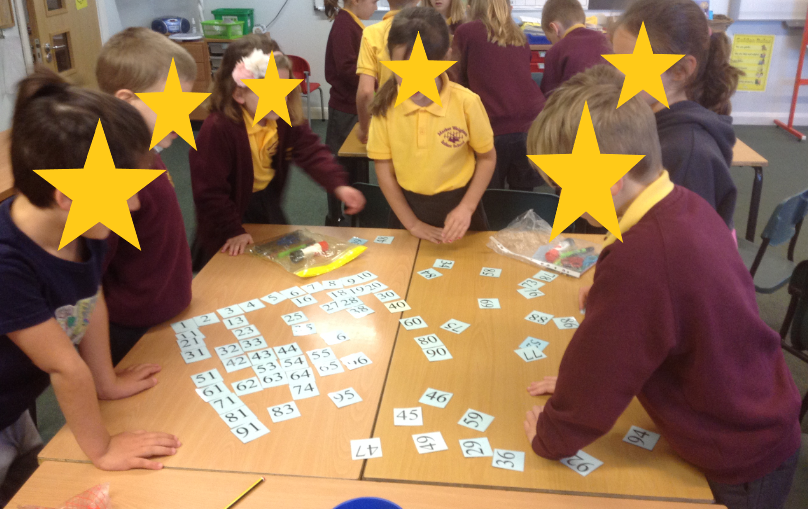
Year 2 children working collaboratively and using their understanding of place value to solve a 100 square problem.
Intent: What do we want children to know about mathematics by the time they leave our school?
Aims of teaching mathematics
Maths is essential to everyday life, financial literacy and most forms of employment, therefore our mathematics curriculum aims to provide our children with a strong foundation in mathematical knowledge and skills. We want their first steps in mathematics to be taken in an environment where all children are nurtured to become confident and enthusiastic young mathematicians.
We believe that helping children to take their first steps into the curious and intriguing world of mathematics will prepare them for their progression through the national curriculum and their future everyday lives. Thereby achieving our school’s core purpose:
To help children to do today what they will be able to do independently tomorrow by becoming confident, successful life-long learners and responsible citizens.
Aiming to give them the best possible start in their mathematics education, we nurture their mindsets so that they can acquire generic problem-solving skills, begin to think logically, reason about their thinking, work systematically and become increasingly resilient and collaborative learners. We create a culture where it is ok not to know something, or to make errors which we can learn from, and we reward and praise effort and perseverance.
Our mathematics curriculum aims to help our children to build a deep understanding of mathematical concepts through fun, engaging and active teaching and learning which progresses in small and logical steps. It enables them to explore, understand and appreciate relationships and patterns in number and to develop number sense and mathematical thinking. We help all children to gain a greater understanding of mathematical concepts by using concrete resources and pictorial representations before moving onto abstract methods.
Teachers are aware that mathematics is not just about acquiring knowledge, but about using and applying that knowledge in different real-life contexts and problem-solving situations. It is about seeing patterns and making links between the things that children have already learnt so that they can see mathematical relationships and develop generalisations, which in turn will help them to develop problem solving strategies and make predictions.
For our youngest children, it is about developing a deep understanding of each number to ten in turn and how this number can be represented in lots of different ways and found in different real-life contexts. For our oldest children, it is about recalling number facts and being able to apply them in different situations. This will help them to become the successful learners and responsible citizens of tomorrow. This grounding in the study of mathematics will give them a firm foundation for their learning at Key Stage 2 and beyond, where they will be able to ‘unlock’ their understanding of relationships and patterns and apply them to more complex mathematical concepts.
Aspiration: we want our children to be curious about mathematics and inspire them to aspire to enjoy and achieve in mathematics in their future schooling.
Independence: children are taught a range of skills over time, using appropriate concrete resources, to help them to develop independence
in representing mathematical concepts and solving mathematical problems. They learn appropriate mathematical vocabulary which helps them to collaborate with others and reason mathematically.
Motivation: we aim to develop children’s motivation and to capture children’s interest in mathematics so that they develop connections between mathematical concepts and can apply their skills in other areas of the curriculum and in everyday life.
By the end of Key Stage 1 our children will be:
- able to relate their mathematical learning to everyday life;
- fluent with whole numbers, counting and place value taught at KS1;
- confident in using the four mathematical operations either practically, pictorially or with abstract methods;
- able to reason mathematically and use mathematical language in their explanations;
- able to apply their mathematical skills to solve problems with increasing complexity.
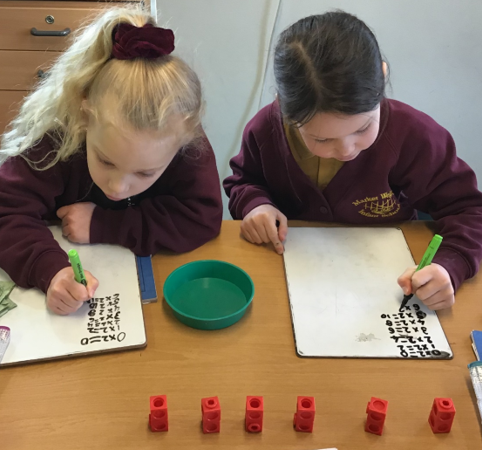
Year 2: Learning two times table multiplication facts.
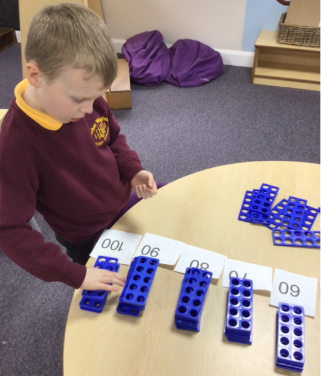
Year 1: Counting in multiples of 10

Links with British values
Our mathematics curriculum offers an excellent context for developing many of the skills and understandings that are intrinsic British Values. It provides opportunities for our children to begin to:
- Practise critical thinking and make decisions.
- Understand democracy.
- Learn to work individually and collaboratively.
- Prepare to play an active role as responsible citizens.
- Develop good relationships and respect the differences between people and their opinions.
- Make connections between cause and consequence.
- Develop ethical and personal values.
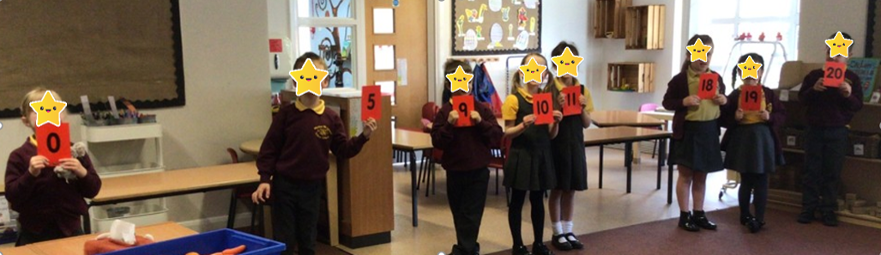
Year 1: Enjoying working collaboratively to form a human number line with missing numbers
Implementation: how is mathematics being delivered?
We adopt a Teaching for Mastery approach whilst following the Statutory framework for the Early Years Foundation Stage (September 2021) and the National Curriculum (2013) programmes of study for mathematics.
Our mathematics curriculum is developed using high quality materials from the National Centre for Excellence in the Teaching of Mathematics (NCETM) and resources from White Rose Maths. It is shaped in the way it is to:
- develop children’s mathematical thinking and fluency;
- enable all of our children to develop a deep understanding of mathematical concepts so that they can make links and broaden their understanding;
- engage all children in mathematical learning and ensure that they are challenged appropriately;
- enable children to work independently, collaboratively and competitively.;
- encourage children to develop a growth mindset and become resilient in solving problems;
- support children to understand the importance of mathematics in everyday life.
We ensure that mathematics plays a key part in our school life beyond our mathematics lessons from registration, across other curriculum subjects, through playground games and within our assemblies.
Concrete is the ‘doing’ stage where children handle physical (concrete) resources. As learning progresses children will use more abstract manipulatives such as counters or cubes. This stage helps children to secure a good understanding of the concept before progressing.
Pictorial is the ‘seeing’ stage where visual representations of concrete resources are used. Children use visual representations and/or create their own images to support them in making a mental connection between the concrete resources and the visual representation.
Abstract is the ‘symbolic’ stage where children use abstract concepts e.g. mathematical symbols. Children are expected to demonstrate a secure understanding of the concept in both concrete and pictorial stages before progressing to the abstract stage.
Although the CPA model is presented in three stages, teachers reinforce concepts by using all stages alongside each other to further embed children’s understanding.
We teach children mathematical concepts at the same pace, differentiated by the use of concrete apparatus or pictorial representations as appropriate, whilst ensuring challenge and mathematical skills progression.
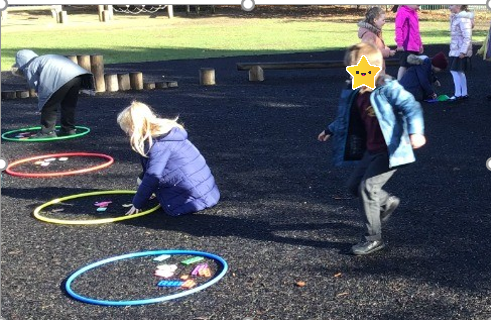
Year 2 active maths: Recalling number bonds to make 10
Many lessons will incorporate mental maths activities to reinforce prior learning. Whilst, some lessons may incorporate ‘active maths’ where mathematical fluency is reinforced through fun, engaging and physically active activities in which the children work collaboratively and/or competitively.
In our Foundation Stages our children learn mathematics through a carefully planned balance of teaching and continuous provision. For our youngest children, in our Nursery, mathematics teaching primarily focusses upon the development of Gelman and Gallistel’s counting principles.
In Reception, the teaching of number is planned so that children develop a deep understanding of each number enabling them to remember more over time. It builds upon their mathematical knowledge and skills by incorporating relevant aspects of shape and measure. For example, they learn about the ‘oneness of one’ exploring the duration of one second and one minute, shapes with one side, one penny and what it is like to be alone.
In Year 1, mathematics is also delivered through a balance of teaching and exploration of continuous provision. In both Year 1 and Year 2, lessons develop children’s mathematical thinking through: whole class teaching/guided practice; opportunities for discussion; independent, paired or small group work; and children’s own questions. Their learning is structured to incorporate opportunities for fluency, varied fluency, reasoning and problem solving.
Teachers differentiate through representations, resources, challenge, questioning and use of scaffolding. All children are challenged appropriately within lessons, and children who grasp concepts rapidly are challenged further.
The importance of using appropriate mathematical language, is encouraged during lessons and teachers place emphasis upon modelling it appropriately. Relevant vocabulary and examples to support learning are displayed on the classroom working wall.
Mathematics can be embedded into many subjects within the primary curriculum. Cross curricular teaching and learning opportunities are planned which incorporate mathematical concepts in a wide range of activities such as PE, art, history and science. We also encourage our children to apply mathematics in real life contexts, such as reading and recording temperatures and working systematically when problem solving.
Progression in mathematics
As children move through our school, mathematics teaching is planned carefully so that children’s learning is progressive. The key elements of the National Curriculum have been organised into a set of hierarchical statements for each area of mathematical skill and are detailed in our Progression in Mathematics document.
Teachers understand the areas to be taught in their year group and are familiar with prior learning so that links can be made and pupils can build on what they already know.
|
From Nursery to Year 2 progression in:
|
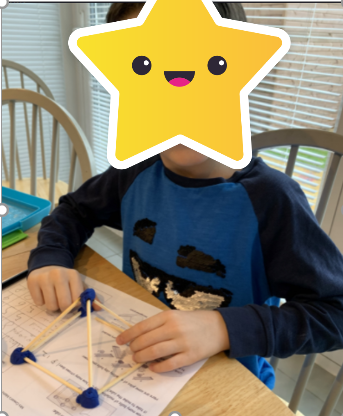
Helping children to remember their learning and make links
We want our children to be able to remember what they have learnt and be able to make links with their prior and subsequent learning. With this in mind, teachers carefully plan their mathematics lessons using a range of high quality strategies:
- Activities that specifically emotionally and intellectually engage our children are planned and delivered to encourage deep learning. For example, working together to solve problems so that all children contribute, feel a sense of accomplishment and understand that making mistakes is an important part of learning.
- Activities that are practical and enable children to learn, practise and apply their knowledge and understanding. For example, starting each new mathematical concept in the concrete phase.
Children are challenged to think so that they can express their ideas.
- For children who find learning more challenging, teachers use a whole range of strategies to help engage them in mathematics. This is personalised according to the individual needs of the child. When children fall behind in mathematics, they receive timely
intervention from their teachers or well-trained teaching assistants.
Staff Training
The profile of mathematics is kept high within our school through ongoing staff development and professional dialogue.
Our maths curriculum leader continues to participate in a Teaching for Mastery Teacher Research Group led by a primary specialist within the Yorkshire Ridings Maths Hub. She continues to successfully disseminate this continuous professional development to our teachers and teaching assistants through staff meetings, development days and professional discussions enabling adjustments to our curriculum and teaching.
A teacher from each year group is participating in the Mastering Number programme developed by the NCETM and is leading this project in their year group.
Wherever possible, our teachers are engaged in discussion of what constitutes high quality teaching and learning in mathematics. These discussions are often set within a practical context of real work children are, or have been engaged in, so that principles emerge from practice and can then be applied to other contexts.
Impact: how is “mathematics” enriching the learning of our children?
The mathematics curriculum matches the breadth of the National Curriculum and Statutory framework for the Early Years Foundation Stage, and provides engaging and well-planned learning activities to ensure a deep understanding of mathematical concepts.
Foundation Stage 2: Exploring “The ‘fiveness’ of 5”
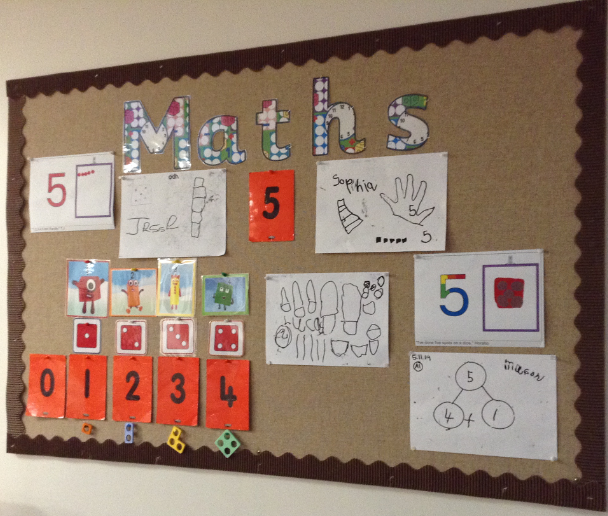
Foundation Stage 2: Working together to show understanding of the composition of 5.
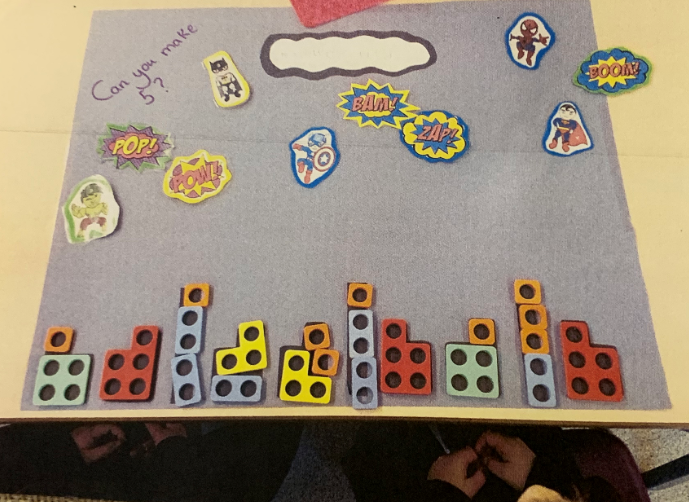
We set the same high expectations for all of our pupils. We believe that all pupils, irrespective of gender, ability, ethnic or cultural origins, should have equal access to all parts of the curriculum and our teaching and learning is structured so that each child has every opportunity to realise their potential within mathematics. All children benefit from the emphasis on the Concrete, Pictorial, Abstract model and collaborative learning, and teachers encourage all children to develop the knowledge, skills and attributes they need to succeed at school and in the wider world.
Teachers use a range of high-quality concrete manipulatives to introduce new mathematical concepts and then build upon this understanding as learning progresses. Children use mathematical representations that will continue throughout their learning. As children enter a new year group, they are well prepared to continue their learning of mathematics because of well-developed understandings of representations, manipulatives and core concepts.
hildren value learning outside of the classroom, such as physically active maths, searching for shapes around the school grounds or measuring plants that they have grown in science. As mathematicians they are keen to apply their skills and knowledge to support other curriculum areas such as calculating how long ago a historical event occurred or counting donations received during fundraising activities.
Conversations with children show that they are interested in and curious about mathematics. For example, a child in one of our Reception classes was curious to find out how long the carpet in his classroom was, so he used his skills to measure it!
From the summer term in Reception children are provided with NumBots accounts and enjoy engaging in developing their key fact recall at both home and school.
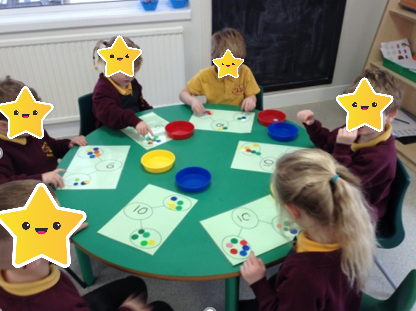
Foundation Stage 2: Using part whole models for addition and subtraction.
Teachers assess pupils’ understanding of key concepts in mathematics well. They check their knowledge and understanding through questioning pupils during lessons, observing practical and/or active maths sessions and asking pupils to explain their answers or reasoning, as well as through marking and statutory assessments. Consequently, pupils are increasingly well prepared to develop their understanding in Key Stage 2. Pupils take their enthusiasm for mathematics into their further studies at Mount Pleasant Junior School and beyond.
Our next steps
- Embed our Teaching for Mastery approach across our school;
- Continue to develop a Teaching for Mastery resource bank;
- Develop a rolling programme of Continuing Professional Development for teachers and teaching assistants;
- Review our assessment processes;
- Review the impact of introducing mastery teaching.